
Doors, portals and flickering interiors: a mapper's explanation
Why FiveM interiors flicker, vanish through doorways or show the outside world: how MLO rooms and portals work and what usually goes wrong with them.
NXBy Team NolX
· 4 min read
If you've ever looked at an MLO's stream folder and wondered why it ships a modified vanilla .ymap with a weird name, there's a decent chance it's occlusion. It's one of the least understood parts of GTA V mapping, and one of the most important for performance.
The fastest geometry to draw is geometry you don't draw at all. Occlusion is how the engine decides that something is hidden behind something else, a building, a hill, a wall, and skips rendering it. Without it, the game would draw every object in front of the camera within its draw distance, including the hundred props sitting behind the warehouse you're staring at.
GTA V uses precomputed occluders. Rockstar baked simple, invisible boxes and meshes into the map data: big blocks representing solid buildings, terrain, walls. At runtime, the engine rasterises these cheap shapes into a low-resolution depth buffer and tests other objects against it. If an object's bounding box is fully behind an occluder, it's culled.
The occluders live inside .ymap files, alongside entity placements. There are two main types:
Interiors (MLOs) have their own culling on top of this, using rooms and portals. That's a separate system, which we cover in our article on portals and flickering.
Here's the problem. Suppose a vanilla building in Grapeseed has an occluder baked around it. A mapper removes that building and puts a new MLO with large windows in its place. The old occluder is still there, invisible, sitting exactly where the walls used to be.
From the engine's point of view, that space is solid. Anything behind it gets culled. The result, in game:
So a proper map has to edit the vanilla occlusion: remove the occluders that no longer match reality, and ideally add new ones that match the new building. That's why good MLOs include modified vanilla ymaps, and why we leave those files unencrypted. If two maps both touch the same area's occlusion, you need to be able to open them and merge the changes.
Some mappers deal with occlusion by deleting all of it in a region. Visually, everything looks fine. Performance-wise, it's bad: the engine now draws everything behind every building in that area. You won't notice in an empty test server, but on a full server with a dense city block it adds up quickly.
A few clear signs that occlusion is wrong near a map:
CodeWalker can display occlusion boxes and meshes if you enable them in the view options, which makes the first two cases easy to confirm.
This is where server owners usually get bitten. Two map resources each ship a modified copy of the same vanilla ymap. Whichever loads last wins, and the other map's changes are lost. If the losing map relied on removed occluders, you get the vanishing walls described above.
How to handle it:
stream folders.find resources -name "*.ymap" -path "*stream*" | xargs -n1 basename | sort | uniq -d
It's tedious, but it's the only clean fix. This is also why I'd avoid maps that encrypt their vanilla edits; you can't merge what you can't read.
You don't need to author occluders yourself. But you should understand enough to recognise the symptoms, to know why maps ship vanilla files, and to check for duplicates when you add a new map to an area that already has one.
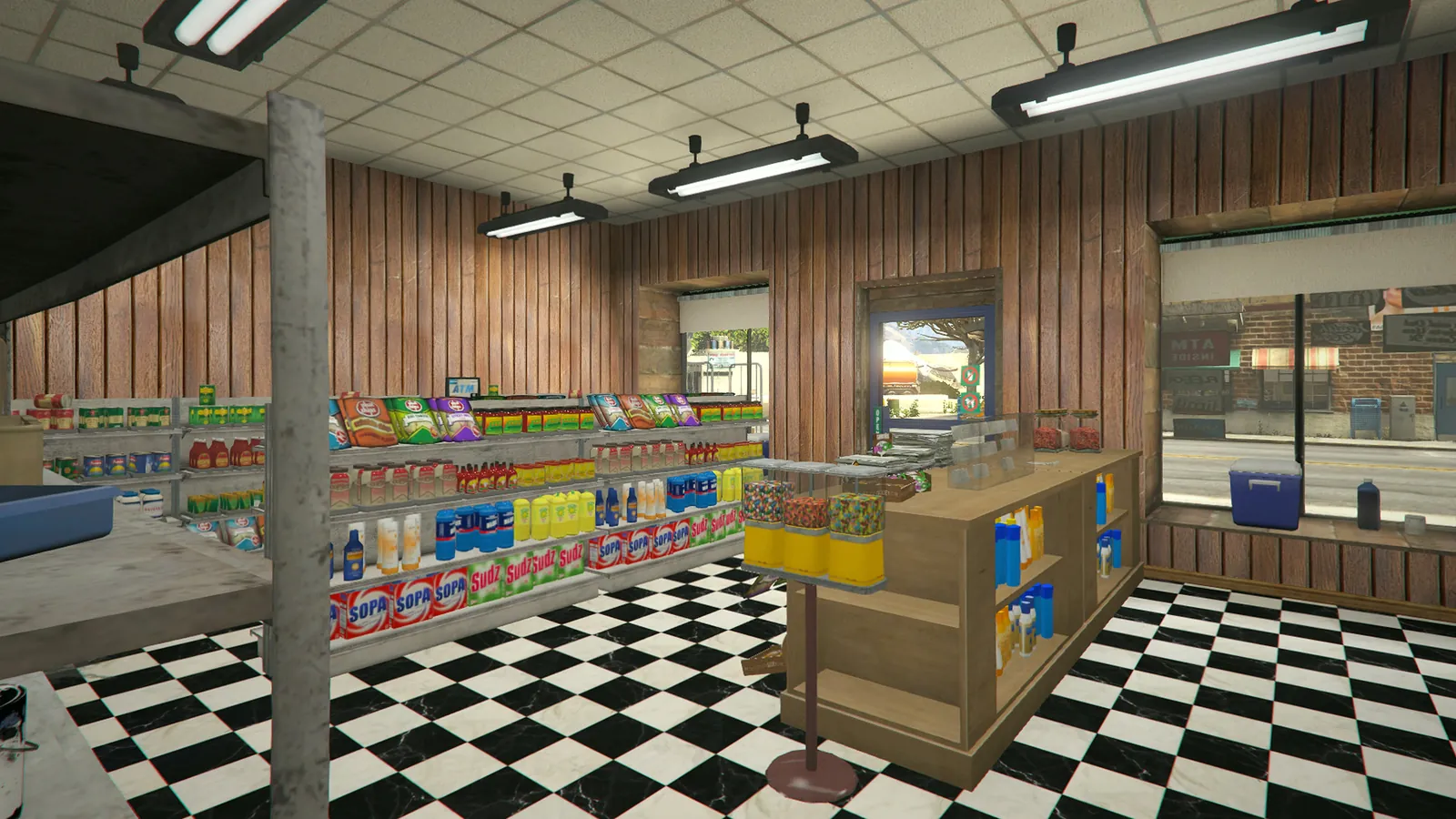
When we build something like the Grapeseed General Store, the occlusion edit is part of the job, not an afterthought. Expect the same from anyone you buy from.
Keep reading
Why FiveM interiors flicker, vanish through doorways or show the outside world: how MLO rooms and portals work and what usually goes wrong with them.
How we light FiveM MLOs so they hold up at noon and at 3 a.m.: real light sources, emissive shaders, per-room timecycle modifiers and the mistakes to avoid.
How Team NolX builds a furnished FiveM MLO, from blockout and CodeWalker to Blender and Sollumz, rooms and portals, entity sets and day and night testing.